
Aralere, Tejas. "Confusion Corner: Yavanas, Kushans, and the Politics of 'Hellenistic Science'." CHS Research Bulletin 14 (2026). https://nrs.harvard.edu/URN-3:HLNC.ESSAY:107501056.
Research in Brief
My research at the CHS developed a structure for my second book project which focuses on what I call the “later legacies of Hellenism” in South Asia from the 1st century BCE to the 4th century CE. I came to this topic from my first book project, “Cosmic Embodiment: Astrological Melothesia in Ancient India and Rome,” which presents a syncretic analysis of the astrological theory of melothesia (the belief that the 12 zodiac signs governed different bodily regions) in Greco-Roman medicine and astral sciences. There I examined the use of melothesia in Manilius’ astrological epic poem Astronomica (30 CE) and the Yavana Jātaka (~150 CE) translated as the “Greek Horoscopy.” Both texts incorporate the melothesia and systemically contextualize it to their political and religio-social scenarios through a process I call “cultural translation.” The Yavana Jātaka was originally translated into English in the 1970s, and it was claimed that the surviving Sanskrit poetic astrological manual originated from a now lost Hellenistic Greek original. While there was exchange of scientific ideas between the Mediterranean and ancient India, and even a settlement of Indian traders in Roman Egypt, scholarship has recently begun to critique this text’s alleged translation history. Rather than following a simple Greco-Arabic model of translation, the Yavana Jātaka appears to represent a process of selective incorporation: theories such as the zodiac and melothesia were integrated into an existing Sanskrit śāstra tradition.
But who were the Yavanas, where did this scientific knowledge come from, and how should we understand the category of “Hellenistic science” itself? I took this as my starting point for my second book project and work while at the CHS. Yavana ultimately derives from Yauna, the Persian-Achaemenid designation associated with Ionia and Greek-speakers in western Asia Minor. But its meaning in Sanskrit sources changed over time and across geographical contexts. The Sanskrit grammarian Pāṇini (6th cent. BCE) in Gandhāra uses the form yavanānī in his grammatical tradition to refer to the Greek script, while later Sanskrit texts employ Yavana referring to peoples living West of the Indus River. Thus, the term likely designated groups that were culturally, politically, and geographically distinct from the Greeks of classical Athens and Hellenistic Alexandria. Yet, they were considered connected to the Greeks by the ancient Indians.
I suggested that the Kushan (Kuṣāṇa) Empire provides a crucial context for understanding this complexity and is included under this Yavana ethnonym. The Kushans emerged from the Yuezhi, Central Asian nomadic herders who migrated southwest from the borders of Han China around the Tarim Basin. At its height, Kushan territory encompassed Bactria, Gandhāra, northern India, and parts of Central Asia; i.e., the Silk Routes. Much of the Greco-Buddhist sculpture excavated from 1st – 4th century CE Gandhara was produced under Kushan patronage, but in Classics and South Asian Studies contexts, this cultural group is rarely mentioned in conjunction with these fascinating material objects.
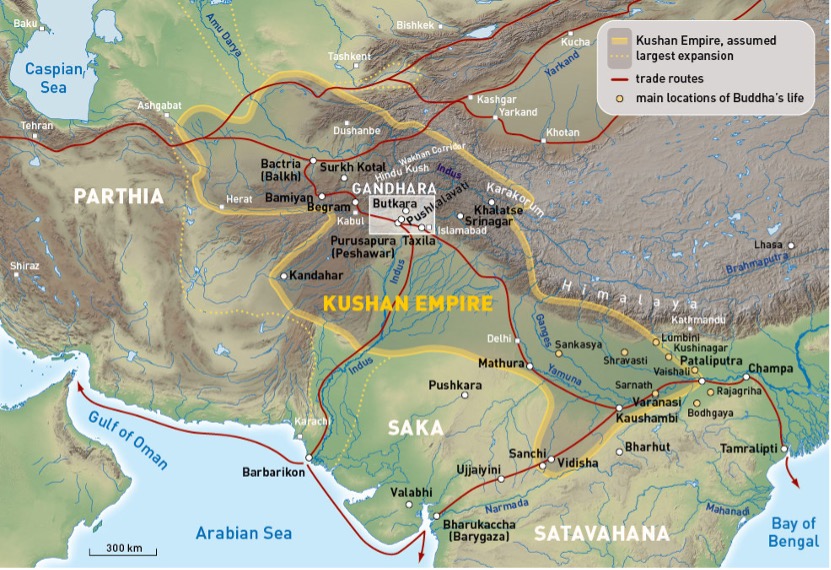
Additionally, Kushan coinage combines Greek alphabetic legends and artistic conventions with Iranian, Greek, and Indian political and religious imagery. Greek deities such as Heracles appear alongside Iranian and Indic divine figures, while royal titles move among Greek, Sanskrit, and Iranian linguistic forms. The Kushans were actively determining their empire’s multicultural identity, so their acceptance of specific religious, political, and cultural practices and ideas that they encountered were deliberate and telling.
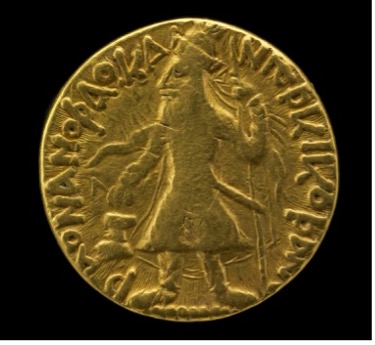
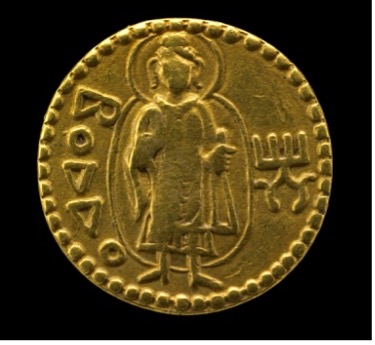
Taxila provides an especially useful setting for imagining these exchanges. Located at the intersection of Indian, Central Asian, Iranian, and Mediterranean worlds, it was associated with learning in grammar, medicine, logic, divination, and astral sciences. Rather than tracing knowledge moving along a single route from Alexandria to India, Taxila allows us to imagine knowledge circulating through networks of multilingual communities and institutions between the Mediterranean, South Asia, and China.
I argue that the Yavana Jātaka belongs to this environment of cultural negotiation. One verse explicitly refers to both Kushan and Śaka (Scythian) systems of reckoning time, demonstrating the practical necessity of reconciling multiple calendrical traditions. Its astrological system likewise incorporates material associated with foreign traditions while embedding that material within a distinctly Sanskrit and Brahmanical intellectual framework. Sanskrit studies can illuminate how those terms were reorganized within the conceptual structures of śāstra. Political history and the study of the Kushan Empire provide the geographical and institutional context in which such exchanges became possible.
The result is a different way of thinking about “Hellenistic science.” Hellenistic science is often associated with Alexandria, Pergamon, Athens, and other Mediterranean centers, and conventionally bounded by the political chronology between Alexander’s death in 323 BCE and the Roman conquest of Ptolemaic Egypt in 31 BCE. But scientific practices do not conform to political periodization and require us to de-center Alexandria to include places like Taxila. If Hellenistic science is characterized by the interweaving of Greek and non-Greek knowledge, new intellectual centers, and royal patronage, then the Kushan world exhibits many of the characteristics traditionally associated with “Hellenistic scientific culture” but is markedly different as described above. Rather, the category becomes more useful when it is understood as a network of encounters instead of as a bounded, Alexandrian cultural phenomenon. Greek technē, Sanskrit śāstra, and Roman ars can be placed alongside one another without assuming that one represents the normative form of scientific knowledge against which the others must be measured. Instead of trying to excavate the Greek origins of ancient scientific ideas, such an approach allows us to ask different questions: why were particular forms of knowledge adopted? How were they transliterated or culturally translated? How were they reshaped when they entered new religious and political environments? And if Greek scientific traditions could be so thoroughly transformed within Sanskrit śāstra, what does it mean to call them “Hellenistic” in the first place?
Grateful Acknowledgments
I recognize that this is a research bulletin, but one must also capture the broader scholarly activities and experiences we shared as a cohort during our time there. I am deeply grateful to Mark, Zoie, Ryan, Olivia, Ruth, Tammy, and the staff for the extensive academic, financial, social, and residential coordination that made the fellowship possible, and to Rebecka, Sophie, and Allison for procuring the library resources I needed. I am also grateful to Chefs Anton and Nuwan for keeping us exceptionally well fed, making CHS feel both a home and a research institution. I was fortunate to be part of such a convivial cohort, learning constantly through conversations with fellows and weekly talks. Because many fellows worked on ancient science, I also coordinated a weekly reading group in which we engaged with some of the “standard” texts of the subdiscipline. Lastly, fellows and community members participated in a colloquium I organized on the artes bringing together faculty from Georgetown and Vanderbilt. These experiences and the intellectual community they fostered could only have happened at CHS. During the Spring, I was invited to present my work at the Harvard CAMLab, Yale’s ARCHAIA group, and in Berlin. I also organized an ancient science roundtable discussion at the History of Science Society conference with travel funding from CHS. Additionally, holding this fellowship in conjunction with the Loeb Classical Library Fellowship allowed me to take a year of research leave enabling me to be a fellow at the Max Planck Institute for the History of Science’s ASTRA group in Berlin and the Fondation Hardt in Geneva. For all these things, I owe the CHS a great debt (or as the Brahmins said, Ṛṇa) of gratitude.