When the Previously Differentiated Become Identical: What the Diachrony of Greek Inflectional Syncretism Can Teach Us

  Marinis, Michail I. "When the Previously Differentiated Become Identical: What the Diachrony of Greek Inflectional Syncretism Can Teach Us." CHS Research Bulletin 14 (2026). https://nrs.harvard.edu/URN-3:HLNC.ESSAY:107406236.


Early Career Fellow in Hellenic Studies 2025–26

1. What GreDIS stands for

The project When the Previously Differentiated Become Identical: What the Diachrony of Greek Inflectional Syncretism Can Teach Us (GreDIS) investigates the complex interplay among three linguistic forces: syncretism (the merging of distinct grammatical forms into a single one), defectiveness (the absence of certain expected forms), and anti-defectiveness (the process by which a language repairs such gaps). The central aim of GreDIS is to trace how these forces interact to reshape the inflectional morphology of Greek nouns across both space and time.

2. Why noun inflection in Classical Greek is “rich”

Greek is traditionally regarded as belonging to the class of languages characterized by rich inflectional morphology. In such systems, in a canonical world, one would expect every case to be morphologically marked so as to be distinct from every other case, while simultaneously encoding all the morphosyntactic information required for its use by the syntax. In Classical Greek (CG), for instance, the sentence ‘Socrates taught Plato’ could be rendered by any of the syntactically synonymous word orders given in (1i)-(1vi).

(1) i. ✓ Σωκράτης ἐδίδαξε τόν Πλάτωνα.
ii. ✓ Σωκράτης τόν Πλάτωνα ἐδίδαξε.
iii. ✓ Ἐδίδαξε Σωκράτης τόν Πλάτωνα.
iv. ✓ Ἐδίδαξε τόν Πλάτωνα Σωκράτης.
v. ✓ Τόν Πλάτωνα Σωκράτης ἐδίδαξε .
vi. ✓ Τόν Πλάτωνα ἐδίδαξε Σωκράτης.
‘Socrates taught Plato.’

The chief factor enabling this free word order in Greek is precisely its inflectional morphology. In other words, in (1i-vi), the inflectional suffix –ης in the form Σωκράτ(ης) ‘Socrates.M.NOM.SG’ is marked for case as [+nominative], which tells us that Socrates is the one doing the teaching, regardless of where he appears in the sentence. Correspondingly, the form Πλάτων(α) ‘Plato.M.ACC.SG’ is marked as [+accusative], indicating that it denotes the one being taught.

In the English examples (2i)-(2vi), by contrast, neither Socrates nor Plato is marked for case. Consequently, moving either noun phrase within the sentence is impermissible. Only the word order in (2i) is grammatical; the remaining structures are either ungrammatical (e.g., 2ii-2v) or correspond to an altogether different meaning (e.g., 2vi).

(2) i. ✓ Socrates taught Plato.
ii. * Socrates Plato taught.
iii. * Τaught Socrates Plato.
iv. * Τaught Plato Socrates
v. * Plato Socrates taught.
vi. * Plato taught Socrates.
‘Socrates taught Plato.’

3. Forces shrinking the nominal inflectional paradigm

3.1 Syncretism
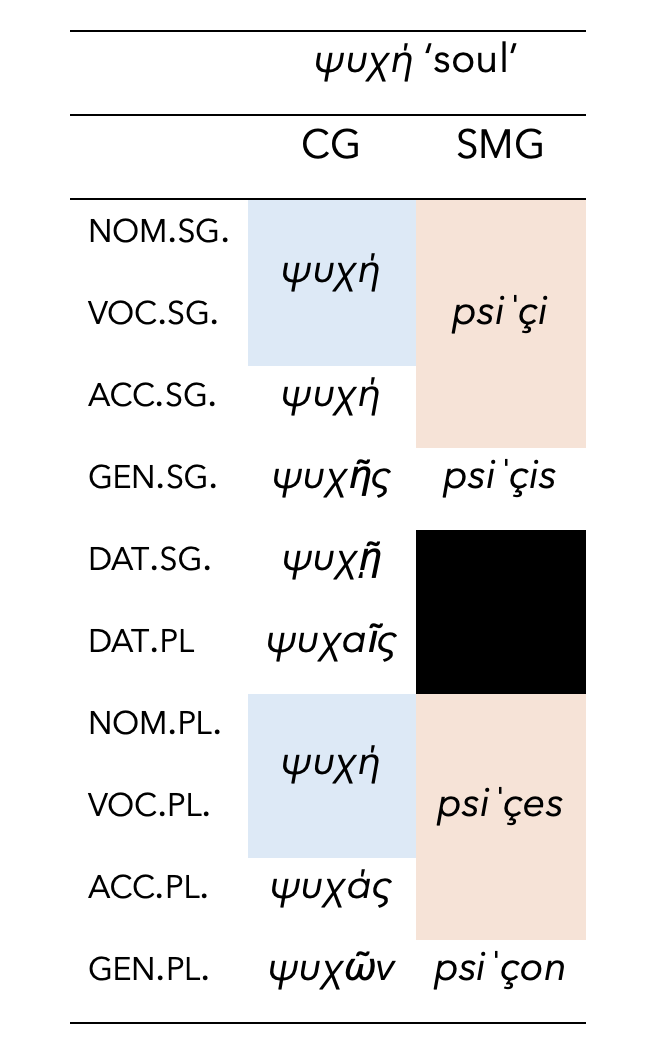
It should be noted, however, that across the thousands of years of linguistic evolution that followed, Greek lost a substantial part of its former richness in nominal inflectional morphology. Let us compare, for example, the inflection of the noun ψυχή ‘soul’ in Classical Greek (CG) and in Standard Modern Greek (SMG), as schematically presented in Table 1.

Table 1: Comparison of the complete inflectional paradigm of ψυχή ‘soul’ in Classical Greek and Standard Modern Greek.
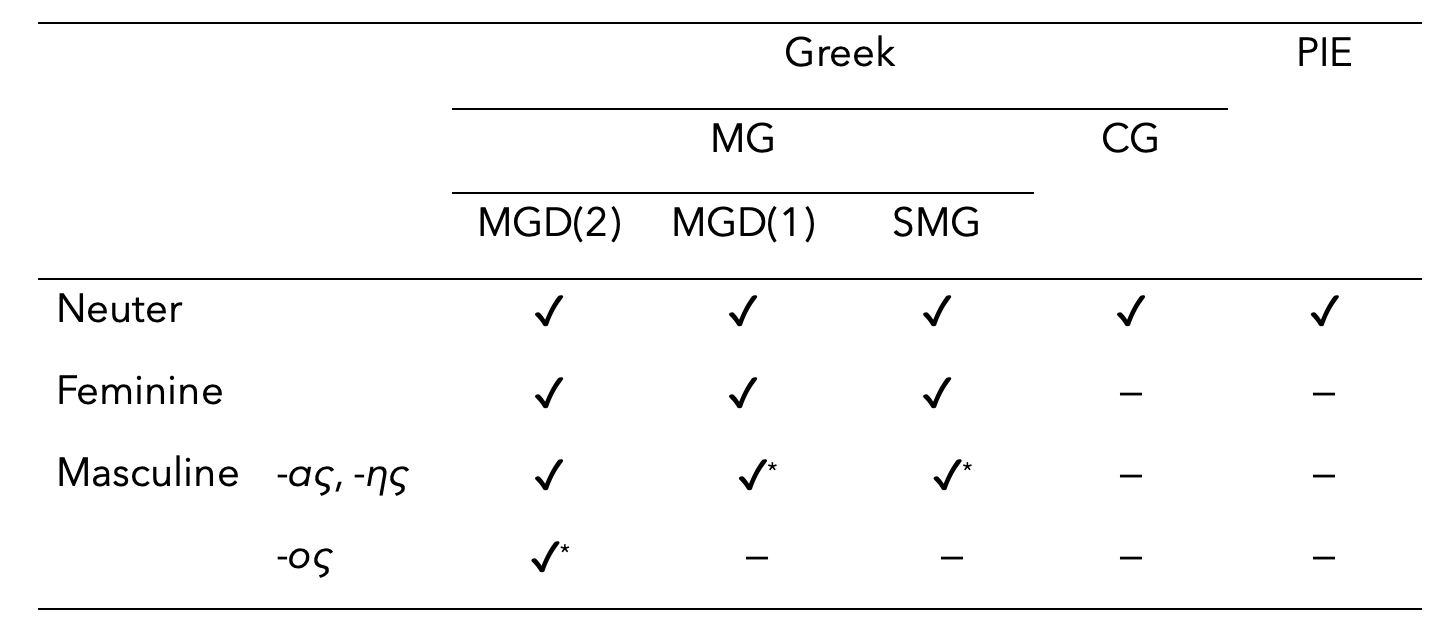
Contrary to the view that has dominated the Modern Greek literature to date, according to which the distribution of syncretic patterns is, in most instances, an accidental by-product of phonological processes, I argue (Marinis 2024) that this distribution is fundamentally morphological—and, more specifically, paradigmatic—in character. Syncretic patterns are driving ongoing changes across all the inflectional classes of Modern Greek (MG) nouns. The most characteristic of these cases concerns the syncretism between the nominative and the accusative, illustrated in Table 2.

Table 2: Distribution of nominative-accusative syncretism among the nouns of Proto-Indo-European (PIE), Classical Greek (CG), Standard Modern Greek (SMG), and two groups of Modern Greek Dialects (MGD1 and MGD2), as proposed in Marinis (2024: 584).
The only case that resists incorporation into syncretic patterns is the genitive plural. I attribute this resistance to purely morphological causes, arguing that it stems from the stability with which a single inflectional suffix (-ων) is used, without exception, across all inflectional classes of Greek to mark the genitive plural. This yields a new inhibiting factor on syncretism, which I have proposed and formulated in (3).

The inter-paradigmatic similarity of a cell, achieved through the inter-paradigmatic realization of the cell with the same inflectional suffix, prevents this particular cell from participating in (intra-paradigmatic) syncretism.
(Marinis 2024: 558)

3.2 Defectiveness

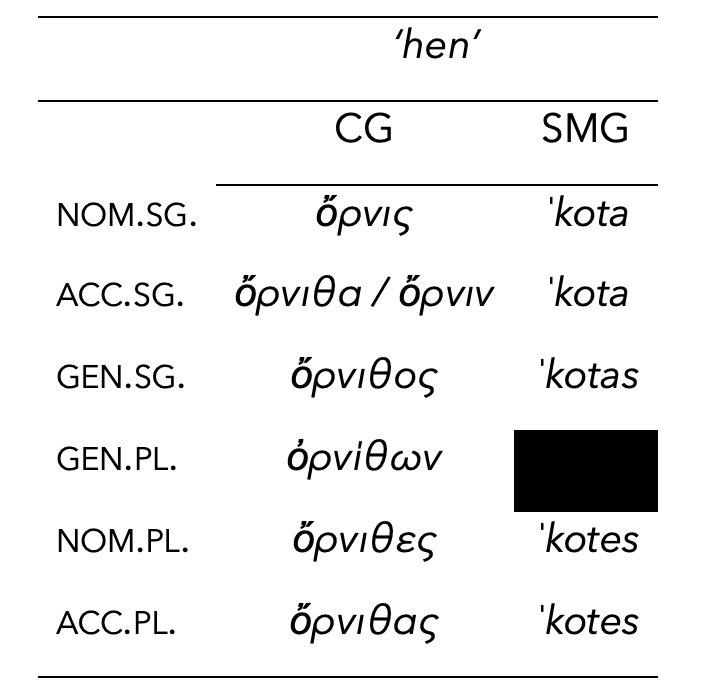
Syncretism, however, is not the only force shrinking the inflectional paradigm of nouns in Modern Greek. Compare, for example, the paradigm of the CG ὄρνις ‘hen’ with the synonymous MG word ˈkota ‘hen’ (Table 3).

Table 3: Comparison of the partial inflectional paradigm of the word meaning ‘hen’ in Classical Greek and Standard Modern Greek.
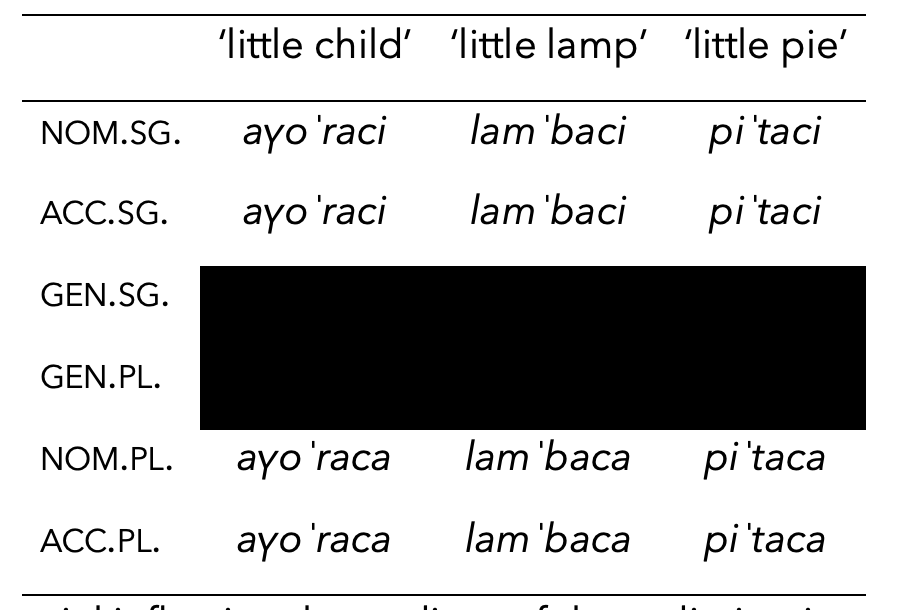
Moreover, entire categories of nouns are invariably defective for both genitive cells—the genitive singular and the genitive plural alike. This is the case for diminutive nouns in –aci (Table 4, based on Marinis 2025: 85-86).

Table 4: The partial inflectional paradigm of three diminutive nouns in –aci in Standard Modern Greek.

4. From rich inflection to uninflectability
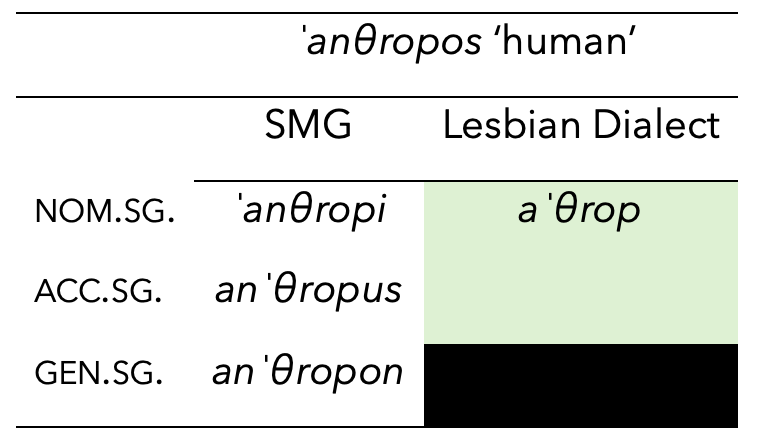
The simultaneous pressure exerted on the inflectional paradigm by the two forces described above drives the system toward a tendency I term uninflectability—a tendency that, in some instances, remains in progress, and in others has already run its course. In the SMG examples presented in Table 4, for instance, it is worth noting that only number is morphologically distinguished today, no longer case: a single form now expresses every case of the singular, and a second, every case of the plural.
In Marinis (in preparation), I argue that this tendency is far less arbitrary than the existing literature on Greek has assumed; on the contrary, it is highly systematic. In certain Modern Greek Dialects, for example, morphological distinctions among the cases of the plural have receded entirely, for every lexeme without exception, regardless of gender or inflectional class.

Table 5: Comparison of the plural sub-paradigm of anthropos ‘human’ between SMG and the Lesbian Dialect.

5. Are They Always Irreversible? Anti-Defectiveness
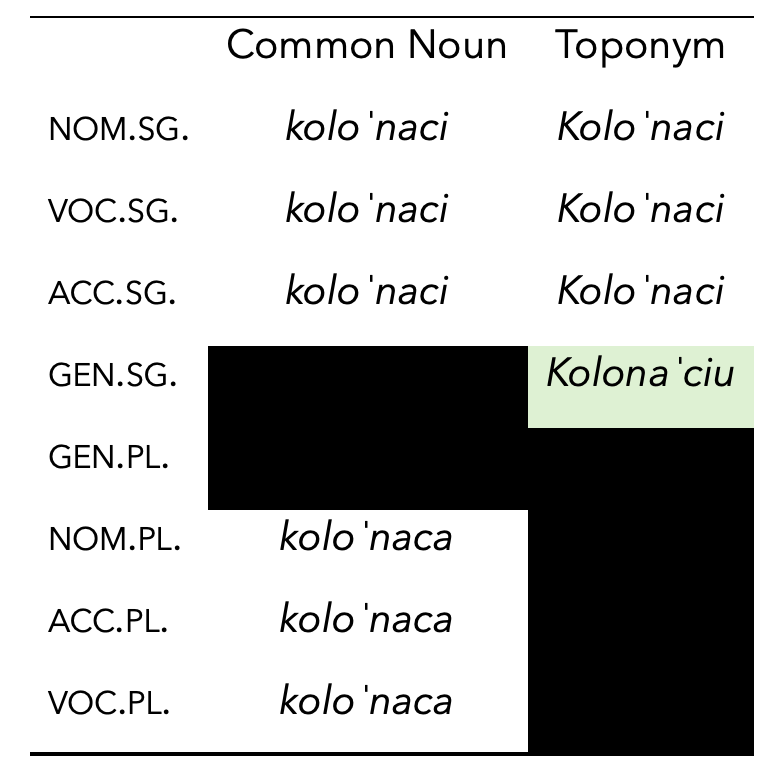
The evolution of Greek nominal inflectional morphology need not, however, be regarded as unidirectionally bound for uninflectability. As I show in Marinis (2025), this trajectory can, in certain cases, be reversed entirely. While common nouns ending in –aci are, for instance, invariably defective for the cells marking the genitive, the homonymous toponyms systematically restore precisely these cells. Compare, for instance, the inflection of the word koloˈnaci as a common noun, meaning ‘little column,’ and as a toponym, referring to a well-known neighborhood in Athens, as shown in Table 6.

Table 6: Comparative presentation of the inflectional paradigm of koloˈnaci as a common noun and as a toponym.

6. Conclusions

Morphological change is often treated as a unidirectional process leading inevitably toward simplification and loss. GreDIS directly challenges this assumption. It is true that Greek nominal morphology is currently undergoing a process of contraction, driven primarily by endogenous linguistic mechanisms and historically amplified by language contact with Turkish, Italian, and the Balkan languages. In certain contexts, these mechanisms operate in tandem to collapse a paradigm almost entirely: in the dialect of Lesbos, for instance, the entire plural is now realized by a single, invariant form.
Yet the most consequential finding of this project is that such loss need not be permanent. By analyzing anti-defective phenomena, I argue that, under identifiable conditions, morphological loss can be reversed. This result offers a considerably more dynamic picture of how the Greek language adapts and evolves across the centuries, and it opens new theoretical terrain within the field.

References

Marinis, Michail I. 2024. “Morphological interpretations of syncretism in the panorama of Greek.” Folia Linguistica, 58(2): 541-562. https://doi.org/10.1515/flin-2024-2021.
Marinis, Michail I. 2025. “On the Morphology of Toponyms: What Greek Inflectional Paradigms Can Teach Us.” Transactions of the Philological Society 123: 77-96. https://doi.org/10.1111/1467-968X.12313.
Marinis, Michail I. in preparation. New insights on syncretism.
Sims, Andrea D. 2015. Inflectional Defectiveness. Cambridge: Cambridge University Press. https://doi.org/10.1017/CBO9781107053854.