
Di Martino, Giovanna. "Rethinking Theatre Translation in the Early Modern Period: The Case of Aeschylus’ Prometheus Bound." CHS Research Bulletin 14 (2026). https://nrs.harvard.edu/URN-3:HLNC.ESSAY:107501057.
My work at the CHS has focused on developing the methodological and digital foundations of The Ecology of Translation: Early Modern Receptions of Aeschylus’ Prometheus Bound (1518–1730). [1] The project asks what happens if early modern theatre translation is reconstructed not simply through relationships between source(s) and target texts, but through the larger visual, textual and performative environments within which such acts of translation took place. During the residency I have pursued this question through three interconnected strands: the construction of translation and visual datasets; the development of an ontology capable of relating them; and an initial proof of concept for computational comparison across textual and visual material.
The most substantial new body of evidence is a catalogue of 209 visual objects connected with Prometheus between approximately 1500 and 1730, assembled from major digital and museum repositories including the Warburg Institute Iconographic Database, the British Museum, the Victoria and Albert Museum, the Metropolitan Museum of Art, the National Gallery of Art in Washington, D.C., the Getty Research Institute, Gallica/Bibliothèque nationale de France, the Morgan Library & Museum, the Royal Collection, Europeana, and the Glasgow Alciato Emblem Database, among others. The catalogue records the material and textual contexts in which images circulated: artist or designer, engraver, publisher, publication, place, date, technique, associated ancient and early modern texts, and links to surviving digital objects.
Its purpose is therefore not to establish that an individual translator demonstrably saw a particular image, but to begin reconstructing the historically available visual field within which Aeschylus’ Prometheus Bound was being read and rewritten: not necessarily what a translator saw, but what there was to see.
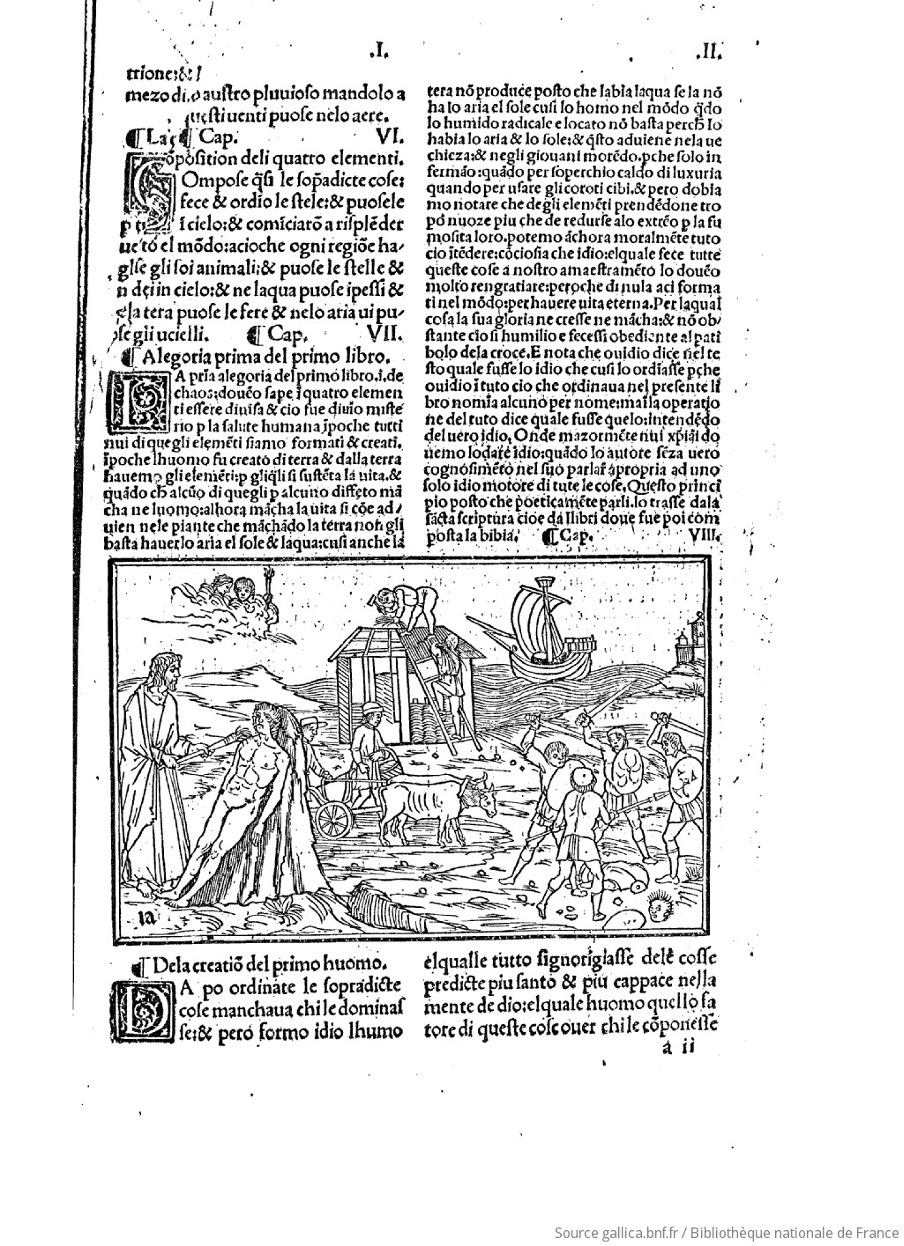
Two major patterns have emerged. The first is the persistence of a long Ovidian tradition of Prometheus as creator of humankind. Medieval and early modern illustrated and moralised versions of Ovid’s Metamorphoses repeatedly represent Prometheus fashioning or animating the first human. In Giovanni dei Bonsignori’s vernacular and moralised Metamorphoses, first printed in Venice in 1497, this identification becomes explicitly Christian: the commentary explains Ovid’s Prometheus as an allegory of the ‘true God’ creating the first human (Bonsignori 1522, 2r), while the accompanying woodcut depicts Prometheus animating their creation through fire [Fig. 1].
The image itself continues an iconographic tradition already visible in the medieval Ovide moralisé, preserved in a manuscript in Lyon (ms. 742, Bibliothèque municipale; 1325-50 ca.) and presenting Prometheus animating humankind through a torch (Ovide moralisé, livre I, 314 in Clier-Colombani 2001, 69). Prometheus the creator could thus enter the sixteenth century as a God-like figure associated with creation, knowledge and human advancement.
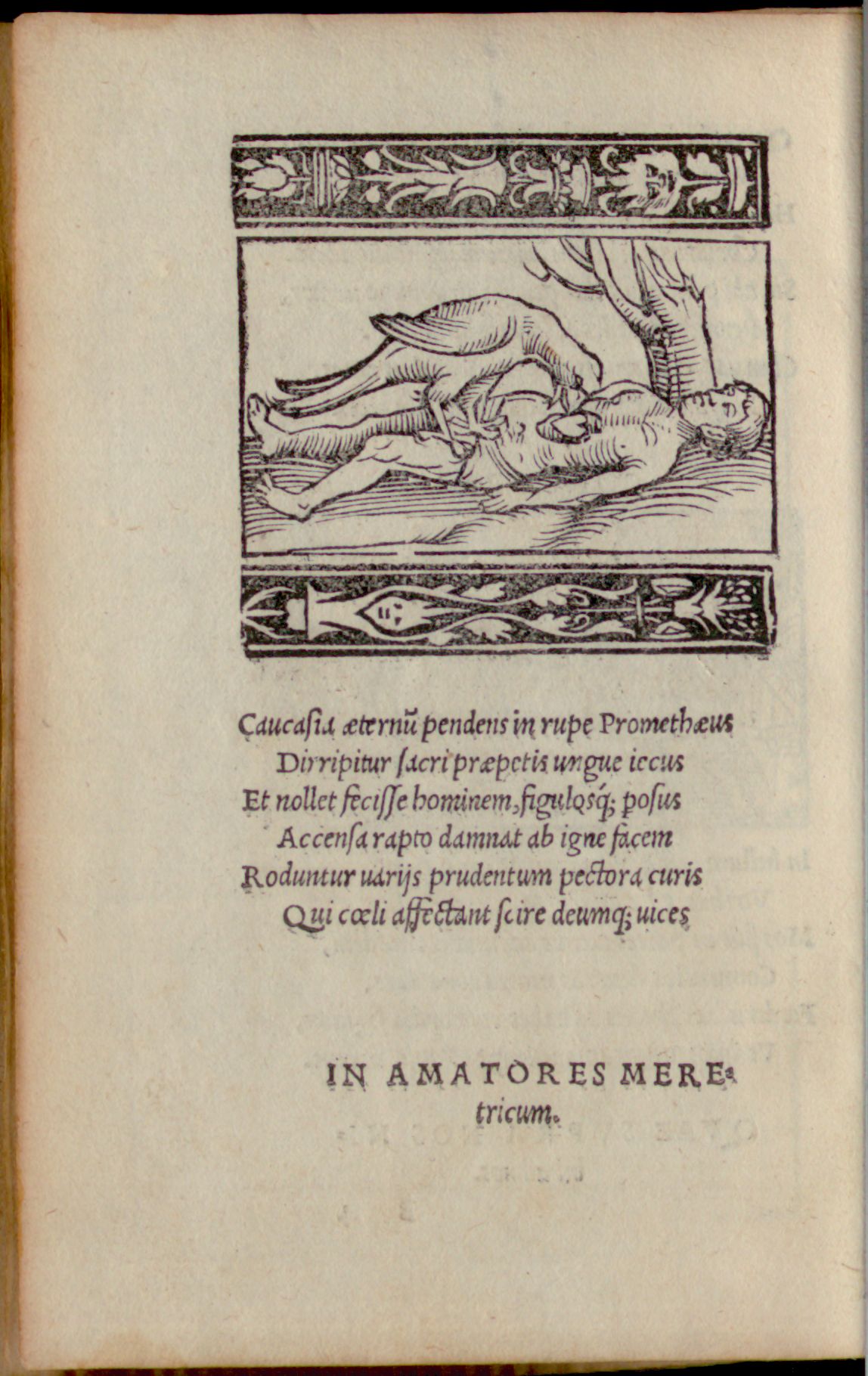
Increasingly, however, this tradition competed with another Prometheus: the punished transgressor. A particularly important vehicle for this interpretation was Andrea Alciato’s Emblematum liber, one of the most widely reprinted emblem books of the sixteenth and seventeenth centuries. In the emblem Quae supra nos, nihil ad nos (‘What lies above us is none of our concern’), Prometheus lies exposed to the eagle while Alciato turns his punishment into a warning against excessive intellectual curiosity – the attempt to know what properly belongs to the divine sphere [Fig. 2].
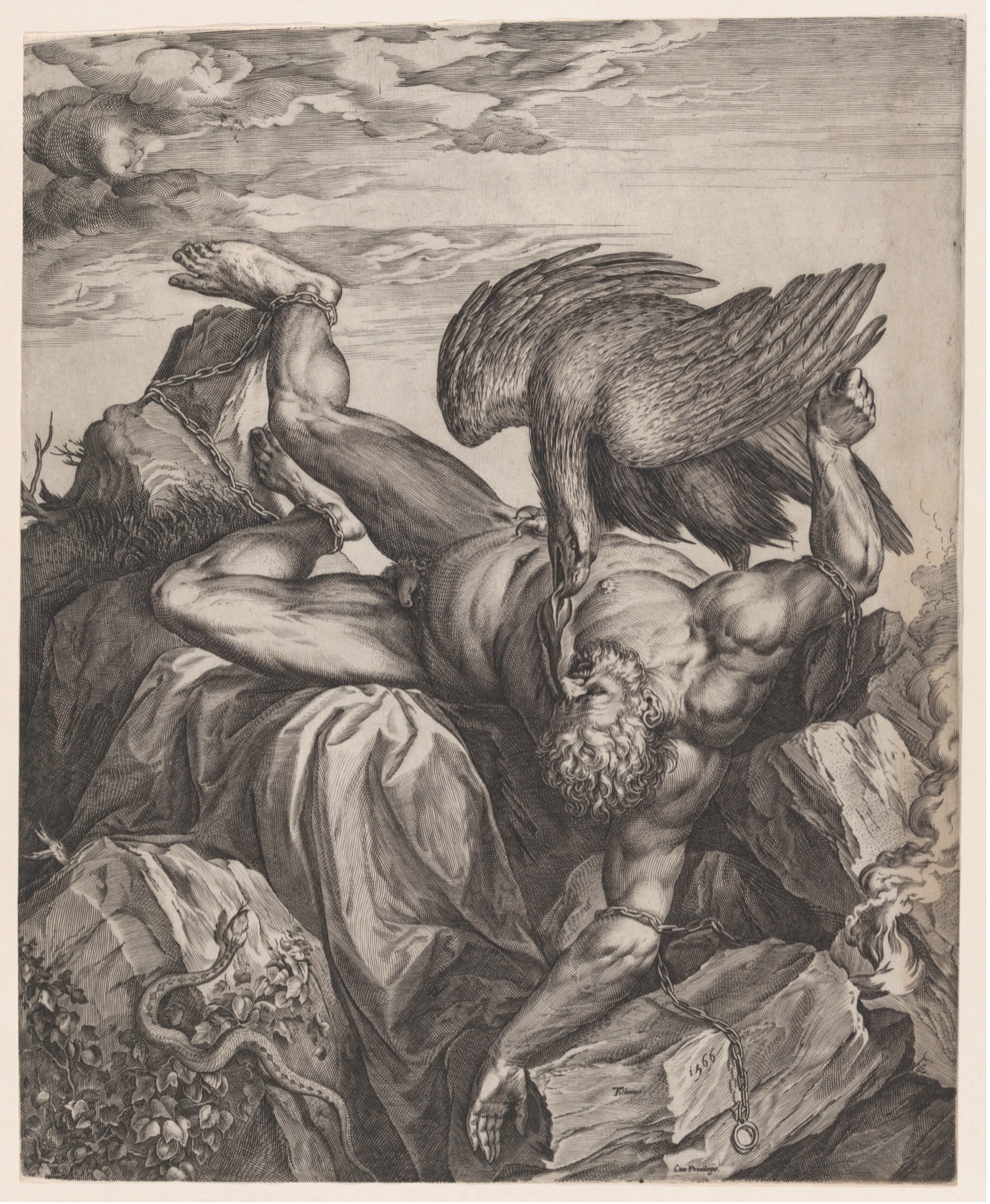
My catalogue currently identifies approximately twenty editions containing this emblem between 1531 and 1621, alongside other particularly fruitful representations of Prometheus’ punishment, including Cornelis Cort’s adaptation of Titian’s Tityus – itself based on Michelangelo’s earlier treatment of the same subject – which transforms the iconography of the punished Tityus into a representation of Prometheus [Fig. 3]. Together, these examples point to a growing and increasingly heterogeneous visual repertoire of Prometheus’ suffering, in which established iconographies of bodily punishment could be transferred and resignified.
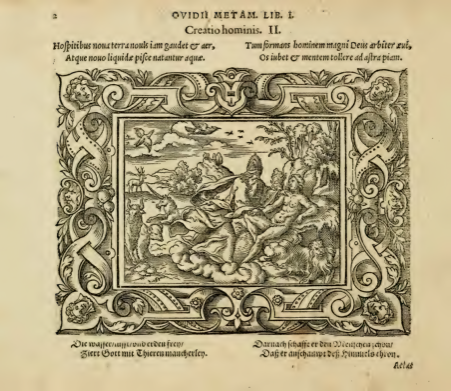
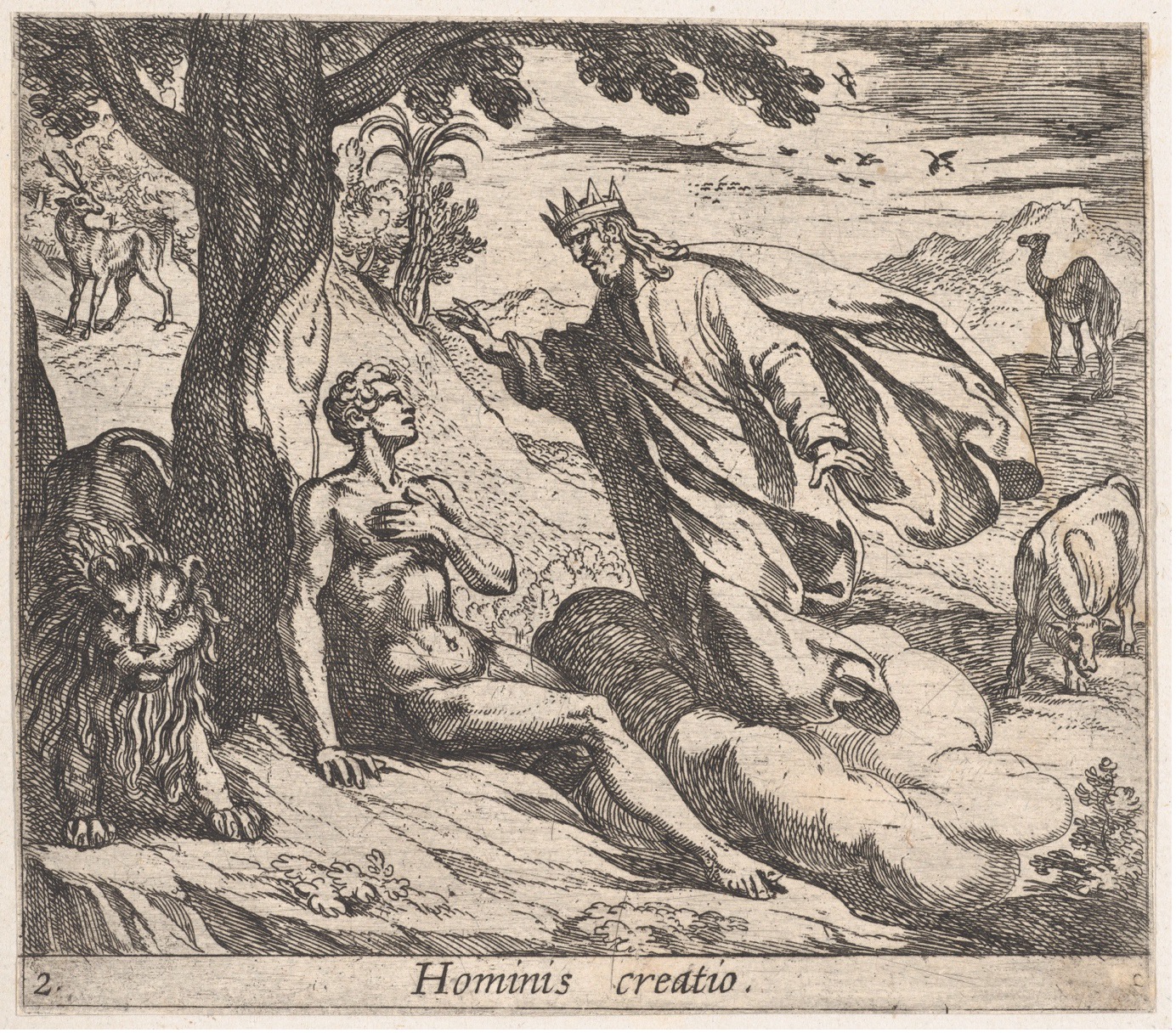
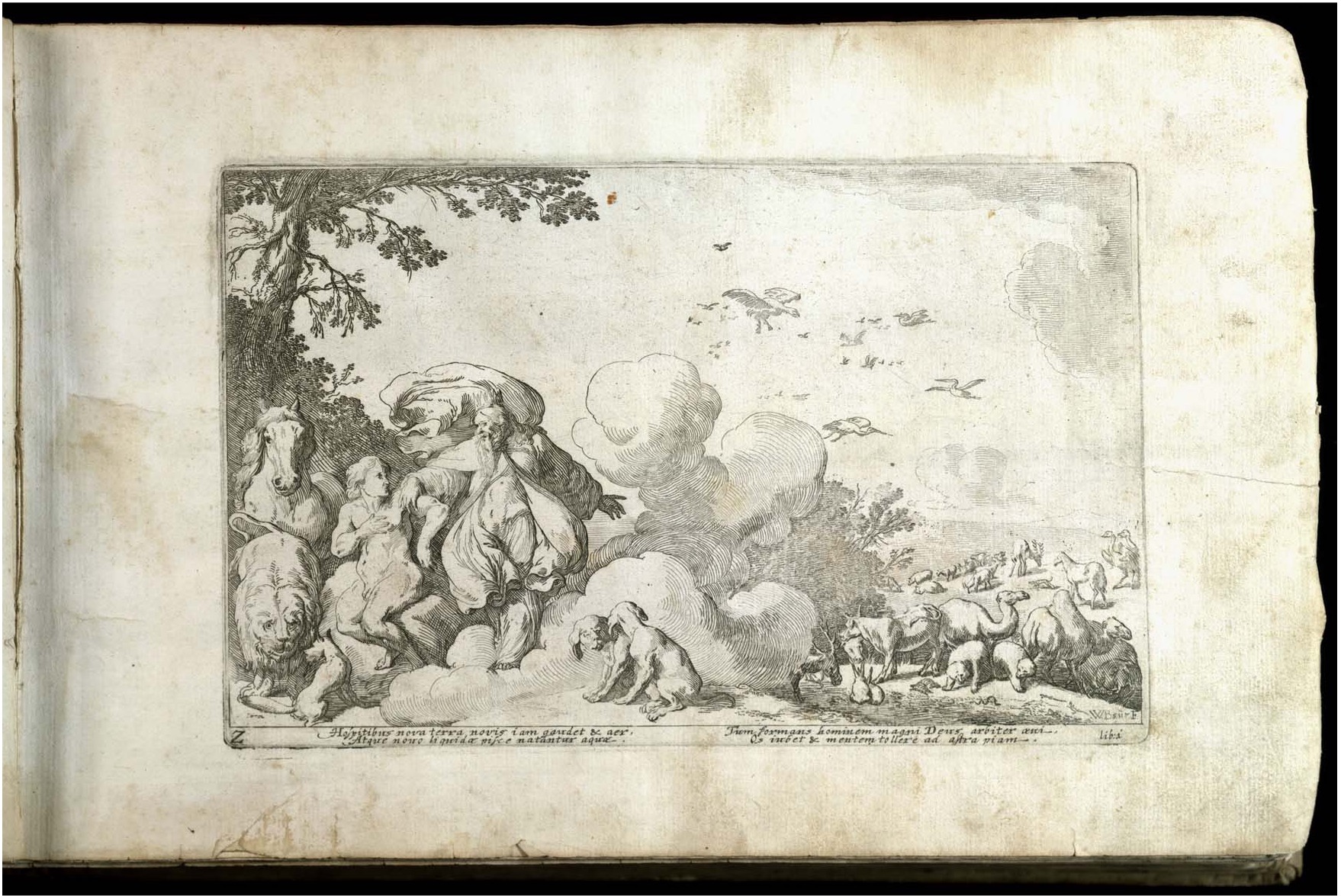
The catalogue also reveals how these meanings travelled through successive combinations of image and text. This is particularly visible in a sequence of illustrations of the creation of humankind, from Virgil Solis’s 1563 woodcut, through Antonio Tempesta’s engraved Metamorphoses cycle of 1606, to Johann Wilhelm Baur’s treatment of the same episode in 1641 [Figs. 4a–c]. The images do not simply reproduce one another: the composition is repeatedly rearranged and reimagined, while remaining part of a recognisable Ovidian visual tradition.
The textual material travelled alongside it. In 1563, the German humanist Johannes Posthius published Solis’s woodcuts accompanied by four-line poems in Latin and German. The tetrastich accompanying the creation of humankind (Creatio hominis) begins Hospitibus nova terra novis iam gaudet et aer and, significantly, identifies the creator not explicitly as Prometheus but as Deus arbiter aevi, ‘God, ruler of the age’. The same Latin verses subsequently accompanied later representations of the scene, including versions associated with Baur [Fig. 4c].
These visual clusters become particularly revealing when placed beside the coeval translations of Aeschylus’ Prometheus Bound. The opposition between creator-benefactor and punished transgressor finds striking correspondences in contemporary readings of Aeschylus. In Coriolano Martirano’s Latin translation, published in Naples in 1556, Prometheus emerges predominantly as a benevolent figure suffering under an unjust ruler: a reading readily compatible with the longer Ovidian and Christian tradition of Prometheus as creator, benefactor and even Christological sufferer (Di Martino 2019, 2023, 2027).
Matthias Garbitius’s 1559 Latin translation and extensive commentary produce an almost opposite emphasis. Garbitius, professor of Greek at Tübingen and a member of the Melanchthonian humanist milieu, interprets Prometheus as the human intellect itself: ingenious, productive and genuinely philanthropic, but dangerously unable to recognise limits. His commentary repeatedly returns to λεωργός, the ambiguous epithet applied to Prometheus at the opening of Prometheus Bound (line 5), which early modern readers could associate either with the ‘fashioner of humankind’ (τῶν ἀνθρώπων πλάστηρ, Etymologicum Magnum) or, more negatively, with the ‘wicked, impious, profane’ (κακοῦργον, πανοῦργον, ἀνδροφόνον, Hesychius; Di Martino 2026 and Di Martino / Baudou 2026). Garbitius exploits this ambiguity, describing Prometheus as excessively industrious, restless, and eager for popular approval (Garbitus 1559, 28; Di Martino 2026). His captivity is justified, Garbitus argues, by an ‘overzealous philanthropy’ (λεωργὸς φιλανθρωπία) by which Prometheus discovers fire and the arts for humanity because he cannot ‘remain at rest’ or ‘observe moderation’ in producing ever more innovations (quia non potuerit quiescere et servare modum in producendis pluribus melioribus et vulgo gratioribus; Garbitius 1559: 28). Elsewhere Garbitius describes this Promethean intellect as constantly inventing, improving and correcting what already exists, extending its activity across both mechanical and liberal arts (Garbitius 1559, b3r). His problem is therefore not knowledge or philanthropy in themselves, but their excess: Prometheus becomes the dangerously zealous human being who seeks, almost, to act in God’s place.
What makes this case especially useful for an ecological model is that meanings remain unstable even when the translated text remains substantially the same. Garbitius’s translation became the basis for a 1609 school production at the Strasbourg Gymnasium. There, however, the emphasis changes dramatically. The production’s German prologue presents Prometheus as the heavenly donor of the liberal arts (Aeschylus/Garbitius 1609, 3r) and connects those gifts with education, civic government (Aeschylus/Garbitius 1609, 7r) and technologies such as printing (Aeschylus/Garbitius 1609, 8v). Added scenes transform the play into a pedagogical performance in which Apollo instructs personifications of Industry, Opportunity, Pleasure and Idleness (Act III), while Prometheus’ Aeschylean account of the arts becomes testimony to the value of human learning (Act V). The same translation that had enabled Garbitus to warn against excessive Promethean intellectual activity could thus be reconfigured theatrically into a celebration of knowledge and civic education. Translation, performance, institutional setting and inherited meanings of Prometheus act upon one another.
The second major outcome of my CHS work has been to give these relationships a formal structure. I have developed an ontology that currently brings together a catalogue of 119 translations and related editions with the 209 visual objects. Translation remains the principal entry point, but each record can connect to editions, commentaries, annotations, people, places, performances and visual objects. Images and translations can in turn be related through shared people, places and dates, as well as through explicit contemporary references, while external identifiers connect people and objects to Wikidata and IIIF manifests, where already available. The ontology therefore translates the theoretical idea of an ‘ecology’ into a queryable structure while preserving the distinction between documented historical connections and interpretative proximity.
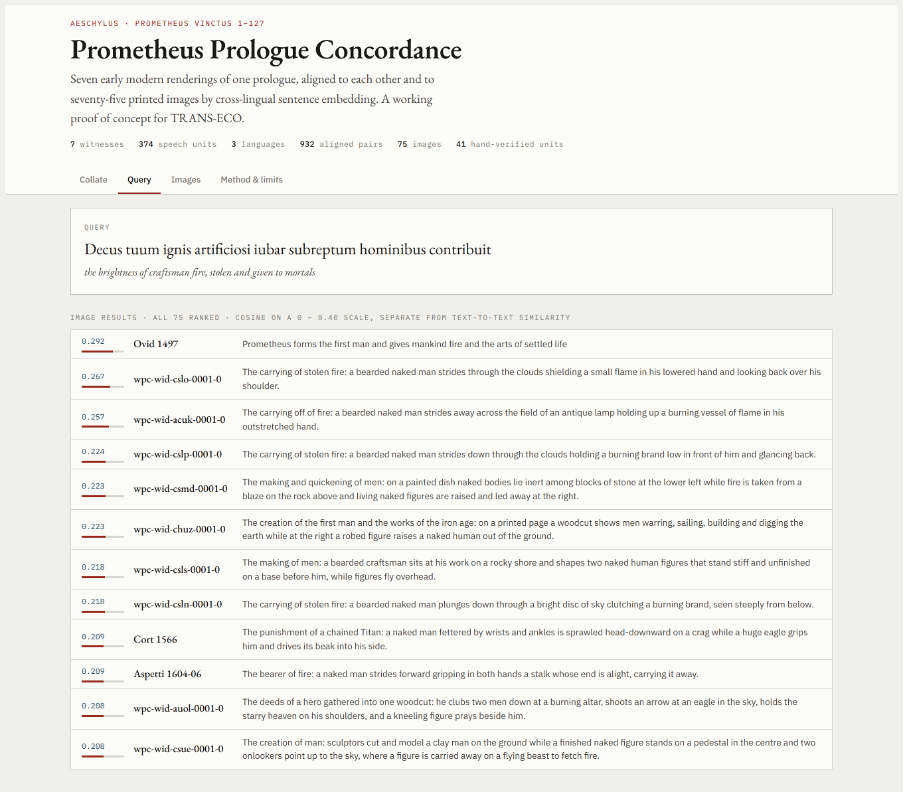
Finally, I have begun testing how this environment might incorporate visual and practice-research material computationally. A proof of concept currently uses structured descriptions of 75 images of the 209 catalogued objects to test whether recurrent iconographic concepts such as creation, fire, chains and punishment can be retrieved in meaningful relation to textual material [Fig. 5]. Initial results are encouraging, while also exposing important methodological limits concerning description, annotation and human interpretation. Particularly suggestive are absences: Kratos and Bia, for example, dominate the opening of Aeschylus’ play but have almost no independently recognisable iconographic existence. The discrepancy between what a text repeatedly names and what a visual tradition chooses to make visible is itself interesting evidence about the making of reception.
The work undertaken at the CHS has therefore moved the project beyond the construction of a digital archive. The next stage is to implement the ontology as a research environment bringing together translations, editions, images, performances and audiovisual documentation generated through practice research. The larger aim is to develop a reusable method for reconstructing the historically situated ecologies within which theatre translation occurs: a tool that asks not only how one text becomes another, but how texts, images, bodies, performances and cultural memories continually participate in making one another.
Figures
Selected Bibliography
Bonsignori, Giovanni. 1522. P. Ovidio Metamorphoseos vulgare. Venice: Rusconi.
Clier-Colombani, Françoise. 2001. “Prologues en images dans l’Ovide moralisé.” In Prologues et épilogues dans la littérature du Moyen Âge, ed. Aimé Petit, 57–76. Lille.
Di Martino, Giovanna. 2019. “The Reception of Aeschylus in Sixteenth-Century Italy: The Case of Coriolano Martirano’s Prometheus Bound (1556).” In Making and Rethinking Renaissance: Between Greek and Latin in Fifteenth- and Sixteenth-Century Europe, ed. Stephen Harrison and Giancarlo Abbamonte, 125–142. Berlin: De Gruyter.
Di Martino, Giovanna. 2023. “Tradurre il teatro per il teatro: presenza e assenza di dialoghi in due adattamenti cinquecenteschi del Prometeo incatenato di Eschilo.” In Le dialogue de l’Antiquité à l’âge humaniste. Péripéties d’un genre dramatique et philosophique, ed. Alice Bonandini, Laurence Boulègue and Giorgio Ieranò, 378–389. Lectures de la Renaissance latine 18. Paris.
Di Martino, Giovanna. Forthcoming 2027. Aeschylus in Italy: Translation, Adaptation and Performance.
Di Martino, Giovanna, and Ezra Baudou. Forthcoming 2026. “New Translational Paradigms and the ‘Rediscovery’ of Aeschylus: Prometheus Bound in Performance.” In Translating Ancient Greek Drama in Early Modern Europe: Theory and Practice (17th–18th Centuries), ed. Giovanna Di Martino and Cécile Dudouyt. Berlin: De Gruyter.
Garbitius, Matthias. 1559. Æschyli Prometheus, Cum Interpretatione M. Garbitii, Basel: Oporinus.
Garbitius, Matthias, ed. 1609. Tragoedia Aeschyli quae inscribitur Prometheus Captivus. Cum interpretatione evidenti ac dilucida, Mathiae Garbitii. Nunc vero ad usum Theatri Argentinensis accommodata…. Strasbourg: Antonius Bertramus.
Footnotes
[ back ] 1. I am grateful to the Center for Hellenic Studies (Harvard University) for the fellowship during which the research underpinning this article was developed. I am especially grateful for the many stimulating conversations over lunches and coffee during my time at the Center, particularly with Naomi Weiss, Director; Ryan Pasco, Associate Director; Allison Thornton, Library Assistant; and fellow Andrés Carrete. Their generosity, intellectual companionship, and interest in the project made my time at the CHS especially productive and enjoyable.