
The Raven & Other Stories: Foundation myths involving birds

  Kessler, Estella. "The Raven & Other Stories: Foundation myths involving birds." CHS Research Bulletin 14 (2026). https://nrs.harvard.edu/URN-3:HLNC.ESSAY:107283905.


The Hellenistic philosopher Timon of Phlius in the third century BC famously described the Alexandrian poets as “squabbling in the bird cage of the muses”. This statement is usually just taken as a funny quip on the scholarly bickering taking place in Hellenistic Alexandria, but my research suggests there is a reason why Timon chose this particular metaphor that represented the Hellenistic world’s heavy engagement with birds in all their forms. At the Center, I studied the occurrences of birds and particularly ornithomancy in Hellenistic times. I specialize in Hellenistic literature, particularly the remains of the scientific scholarship conducted by the Hellenistic poets in Alexandria. I have just finished a monograph — based on my PhD thesis — on Callimachus’ paradoxographical fragments expanded with a critical edition, translation, and commentary.
Birds play a variety of roles in Hellenistic literature, but evidence particularly for ornithomancy is surprisingly hard to come by in this period: hence, my research explores the presence of birds also in the arts, historiography, and epigraphic sources to reach a holistic picture of the period. The practice of augury had likely declined in popularity by this time. The Hellenistic treatment of birds bridged the gap between Archaic and Classical Greek as well as Roman times but is comparatively understudied. My research analyzes how much of this emphasis on bird omens is a nod to previous Greek literature rather than reflecting contemporary real-life practice. Birds are ubiquitous and appear in different functions: as narrative devices, mythological characters, symbols for melodic singing, as part of magical rituals and popular wisdom, or as indicators of weather change. Yet, scholarly discussions are scattered and do not amount to a coherent picture. I aim to prove that birds played a special role in Hellenistic literature above all other animals, probably inspired by the impact of Aristophanes’ Birds. This work lays the groundwork for a monograph on this topic accompanied by two couple articles.
During my fellowship, I especially worked on the foundation myths connected with bird sightings that will occupy a separate chapter in my book. Aristophanes’ Birds is a hitherto untapped source for Hellenistic conceptions on birds. Its central theme, the establishment of Nephelokokkygia (Cloud cuckoo land) deals with colonization and the foundation of cities, very prevalent concerns in the Hellenistic world. Yet whereas the influence of Aristophanes’ Frogs on Hellenistic poetry has been amply explored, the allusions to the Birds still wait to be uncovered. In Hellenistic times, birds adopt speaking roles on a much larger scale than ever before outside of fables. Birds feature in the foundation myth of the very city the Alexandrian scholars lived in. According to Plutarch (Alex. 26.5-6) Alexandria was a city designed on the chalkboard by Alexander the Great, but when it came to outlining the city no chalk was at hand and its boundaries were marked out with soldiers’ barleymeal. Suddenly a large flock of birds from the lagoon descended and ate every piece of the barleymeal. Alexander’s personal seer Aristander of Telmessos interpreted this omen as favourable and prophesied that the city would be bountiful. The Lykian city Telmessos boasted a long tradition of diviners who are already mentioned by Herodotus (1.78.2-3). It is therefore not surprising to read an epigram posing as an epitaph by the Macedonian poet Posidippus on Damon of Telmessos, which mentions his ornithomantic faculties (AB 34).

ἐκ τούτου <τοῦ> πάντα περισκέπτοιο κολωνοῦ
  Δάμων Τελμησσεὺς ἐκ πατέρων ἀγαθὸς
οἰωνοσκοπίας τεκμαίρεται· ἀλλ’ ἴτε φήμην
  καὶ Διὸς οἰωνοὺς ὧδ’ ἀναπευσόμ̣ε̣[νοι.]
From this very hill seen from all sides Damon of Telmessos, gifted in bird-augury from his forefathers proclaims; but come here and ask for Zeus’ prophetic utterance and signs.

Or is it? The evidence for mantics from Telmessos is thin for Hellenistic times and the possibility exists that this Damon of Telmessos is completely fictional and built on the literary and historical precedent. At least in the otherwise detailed historiography on Alexander the Great, the three bird omens mentioned in Posidippus’ epigrams do not feature, which should make us suspect that these are mere inventions. Already Hesiod in the last line of his Works and Days counted ‘the man blessed who knows the flight of birds’. The gods in the Iliad regularly metamorphose into birds. It is therefore easy to see where the motivation to integrate birds into the literary discourse came from. There are many such foundation myths connected with birds: less propitious was apparently the unidentified harpasos bird of prey according to Callimachus (fr.43.58-67 Pfeiffer) unless it was followed by a heron. Callimachus’ own hometown enjoyed the most propitious sign of all: Apollo led Battos, the founder of Cyrene, to the ideal spot for the city in the shape of a raven (Hymn to Apollo, ll.65-8).
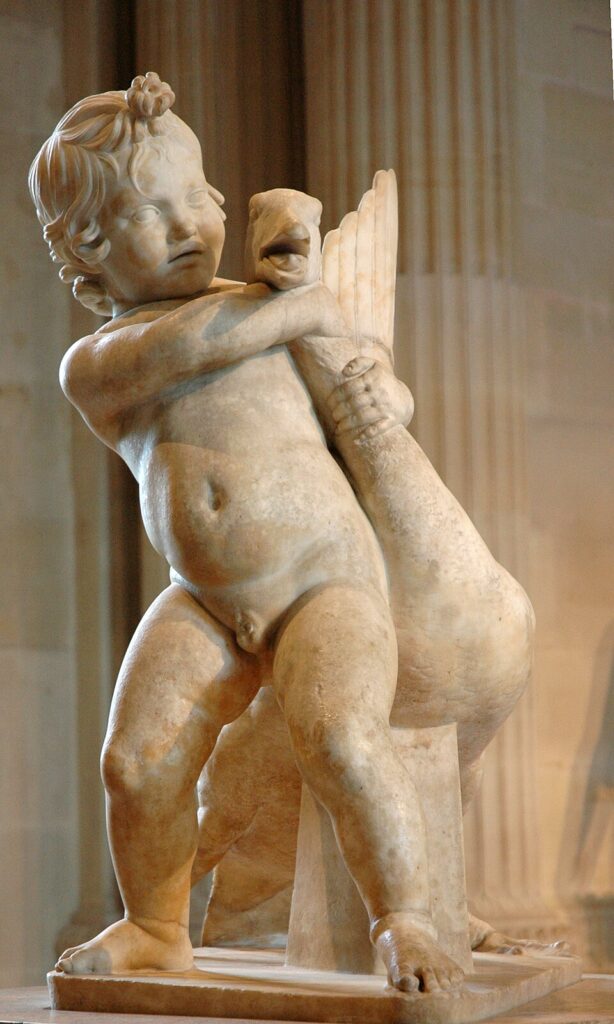
An important role also plays the Egyptian environment in which the Alexandrian poets were operating in. Even if Egyptian traces are comparatively rare in Hellenistic poetry, the complex Egyptian religious belief system included the observation of the flights of birds. The Egyptian perceptions about particular birds often differed markedly from Greek ones, which opens a further route for exploration. My research is further aided by archaeology: often Hellenistic sculpture and pieces of art mentioned in the literature survive as archaeological remains, such as the famous statue of a boy strangling a goose (Herodas, Mime 4.31).
Roman copy (1st-2nd century AD) of a 2nd-century Greek original by Boethos of Chalcedon; Louvre Collection.
The picture is further complemented by mosaics, patterns of which were often disseminated across the Mediterranean from Alexandria’s mosaicists, so that the parrot mosaic in the royal palace at Pergamon had an equivalent in the royal Alexandrian quarters. Mosaics are perhaps the most consistent pieces of evidence apart from the literature for birds in the Hellenistic world.
During my time at the Center, I also had the chance to start a collaborative project on an article on Callimachus’ Pinakes for an edited volume on ancient titles to be published with Cambridge University Press. My collaborator Professor Nita Krevans visited the center for this project. Working in a dedicated research Classics library and being able to pull all the necessary books from the shelves on demand was a fitting start to a research project dedicated to Callimachus’ monumental ancient bibliography, which shaped library organisation for two subsequent millennia.

Bibliography

Arnott, G. (2007), Birds in the Ancient World from A-Z (Abingdon).
Austin, C. and Bastianini, G. (eds.) (2002), Posidippi Pellaei Quae Supersunt Omnia (Milan).
Baumbach, M. (2004), ‘Winged Words’. Poetry and Divination in Posidippus’ Oinoskopika’, in B. Acosta-Hughes, E. Kosmetatou, and M. Baumbach (eds.), Labored in papyrus leaves: Perspectives on an epigram collection attributed to Posidippus (P.Mil.Vogl.VIII.309) (Cambridge, MA).
Dillon, M. (1996), ‘The importance of Oionomanteia in Greek Divination’, in A.M. Hakkert (ed.), Religion in the ancient world: new themes and approaches (Amsterdam).
Dunbar, N. (1998), Aristophanes’ Birds (Oxford).
Gaukroger, L.J. (2016), Independent Diviners in Classical Greece (5th and 4th centuries B.C.) (Diss. University of Kent).
King, C.J. (2004), Alexander and divination: Dreams, omens, and Aristander of Telmessus in the Alexander historians, (Diss. Brown, Providence, RI).
Massimilla, G. (1996). Callimaco: Aitia, libri primo e secondo (Pisa).
Mynott, J. (2018), Birds in the Ancient World (Oxford).
Pfeiffer, R. (1949-53), Callimachus. Fragments, 2 Vols. (Oxford).
Pollard, J. (1977), Birds in Greek life and myth (London).
Steiner, D. (2007), ‘Feathers Flying: Avian Poetics in Hesiod, Pindar, and Callimachus’, AJPh 128.2: 177–208.
Wentworth Thompson, D. (1895), A Glossary of Greek Birds (Oxford).